

What You Must Know Before Buying Off-Plan Property in Dubai
If you are buying off-plan property in Dubai in 2026, you are entering one of the world’s most active real estate markets — but also one where asking the wrong questions, or none at all, can cost you hundreds of thousands of dirhams. Off-plan transactions now account for over 62.6% of all residential sales in Dubai, with more than 134,000 deals recorded in 2025 alone. The pace has only accelerated into 2026.
Before you sign a Sales Purchase Agreement (SPA), there are 10 non-negotiable questions every buyer must ask — covering developer credibility, RERA escrow verification, construction timelines, payment structures, resale restrictions, and exit strategy. This guide answers all of them.
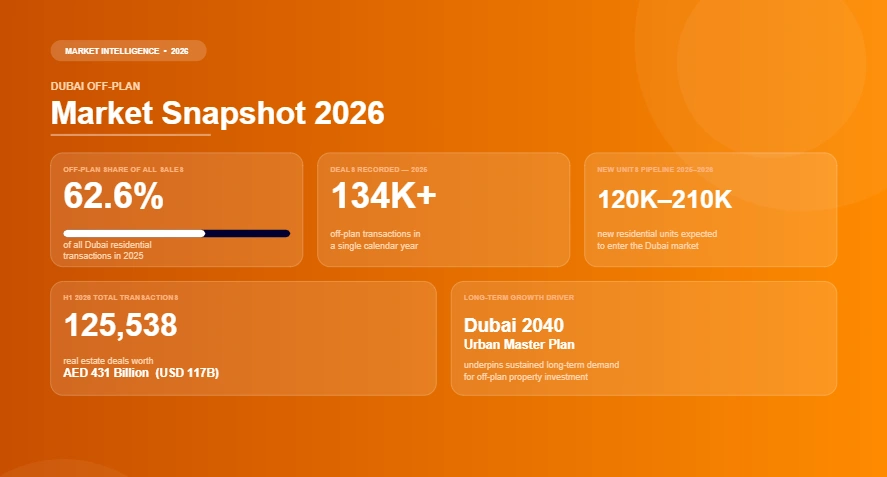
With 120,000–210,000 new units entering the pipeline across 2025–2026 and the Dubai 2040 Urban Master Plan reshaping key freehold zones, the market rewards informed buyers and punishes impulsive ones. The 10 questions below are your due-diligence checklist.
Q1. Why Developer Track Record Matters When Buying Off-Plan Property in Dubai
Before doing anything else when buying off-plan property in Dubai, verify that the developer is registered with RERA and has a clean, documented delivery history. A developer’s past performance is the single most reliable predictor of your handover experience.
Use the Dubai REST App or the DLD Oqood Services portal to check developer licensing, active project registrations, and any history of stalled or cancelled developments. If a developer has three or more delayed projects on record — proceed with serious caution.
Also distinguish between a master developer (e.g., Emaar, Nakheel, Meraas) and a sub-developer operating under a master community. Sub-developers carry higher delivery risk if they lack independent financial backing. Always ask: has this developer delivered at the same scale and quality before?
Developer Verification Checklist
What to Check | Where to Check It | Red Flag |
|---|---|---|
RERA developer registration | Dubai REST App → Developer Directory | Not listed or expired licence |
Past project delivery history | DLD Portal → Completed Projects | 3+ delayed or abandoned projects |
Escrow account status | RERA Escrow Account Services | No active escrow account linked |
Master vs. sub-developer status | DLD Oqood Services portal | Sub-developer with no master guarantee |
Court or legal disputes | Dubai Courts public records | Active litigation against developer |
Q2. RERA Escrow Account: A Non-Negotiable Check Before Buying Off-Plan in Dubai
Under Dubai law, every legitimate off-plan project must have a RERA-supervised escrow account before any buyer funds can be accepted. This is non-negotiable — and it is your single most important financial protection in any off-plan transaction.
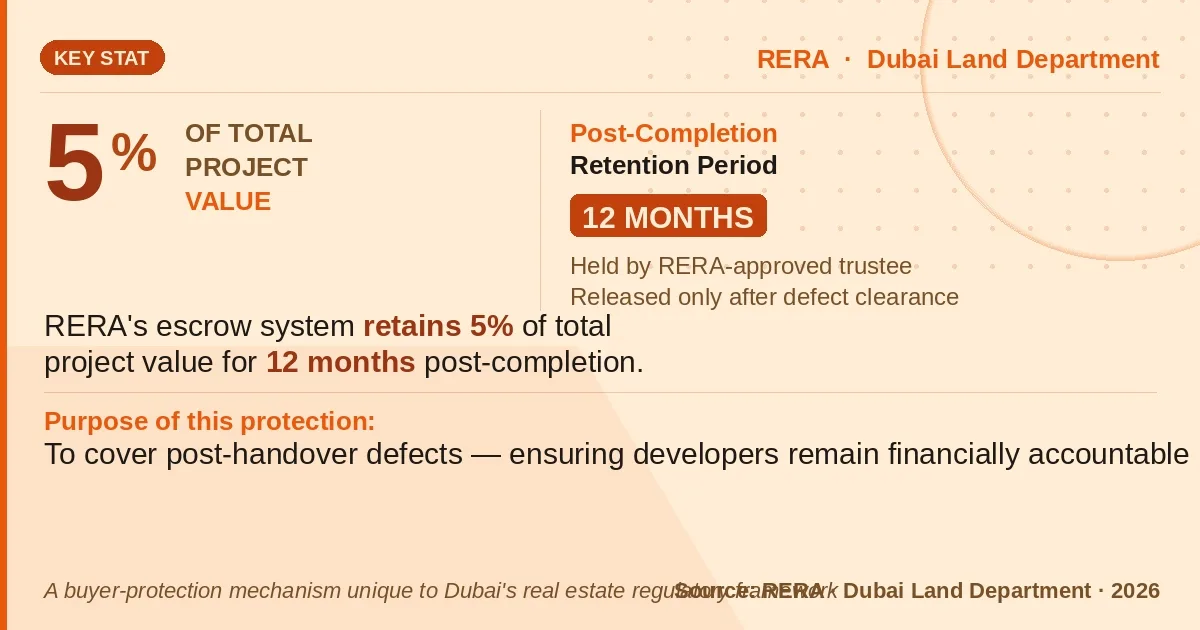
Payments you make do not go directly to the developer. They are held by a RERA-approved trustee and released only after independent construction milestone verification. Furthermore, RERA retains 5% of the total project value for one year after completion to cover post-handover defects. Verify the escrow account status on the DLD Escrow Account Services portal before transferring any money. No active escrow account means no legitimate off-plan project.
Q3. What Are the Construction Milestones for Off-Plan Property Purchases in Dubai?
A legitimate developer will provide a written construction schedule tied to payment triggers. Vague timelines — “completion in 2027” with no staged breakdown — are a serious red flag in the Dubai off-plan market.
RERA’s mandatory escrow system ties every disbursement to a specific construction milestone verified by an independent engineer. This mitigates developer risk considerably, but only works in your favour if you track it. Use the RERA project tracker or the Dubai REST App to monitor construction completion percentage in real time.
Ask the developer to show you the RERA-approved project completion certificates for previous phases. If they cannot produce them, or if the RERA tracker shows less than 20–30% completion while they claim the project is well underway — verify independently before proceeding.
Q4. How Do Payment Plans Work When Buying Off-Plan Property in Dubai?
Dubai off-plan payment plans in 2026 range from 50/50 to 80/20, with post-handover plans extending payments over three to five years. Understanding every tranche before signing is essential when buying off-plan property in Dubai — a missed payment can result in penalties or even contract cancellation.
The most common structure today is the 60/40 payment plan: 60% paid in installments during construction, 40% on handover. However, many developers are now offering back-ended post-handover payment plans to attract buyers — where the balance is paid over several years after you receive the keys. Always check whether the DLD 4% transfer fee is covered by the developer (a common 2026 incentive) or falls to you.
Common Off-Plan Payment Structures in Dubai — 2026
Plan Type | Structure Breakdown | Best For |
|---|---|---|
60/40 (most common) | 60% during construction, 40% on handover | Buyers wanting cash flow flexibility |
70/30 | 70% during construction, 30% on handover | Investors planning to flip before handover |
80/20 | 80% during construction, 20% on handover | End-users seeking lower post-handover burden |
Post-Handover Plan | 40–50% during, balance over 3–5 yrs post-handover | First-time buyers & long-term residents |
1% Monthly | Equal monthly payments over entire timeline | Salaried professionals, steady income earners |
Q5. What Does the SPA Cover for Dubai Off-Plan Investment Buyers?
Never sign a Sales Purchase Agreement (SPA) without a qualified legal review. The SPA governs every aspect of your purchase — and the clauses that matter most are often buried in the fine print.
Key elements to review: the delay penalty clause (typically 5–10 AED per square foot per day after the grace period), the defects liability period (minimum one year under Dubai law, typically covering structural defects for up to 10 years), the cancellation terms, and the handover grace period — which is normally 6 to 12 months before penalty clauses activate.
Ensure your purchase is registered via Oqood registration with the Dubai Land Department. The Oqood certificate is your legal proof of ownership during the construction phase. Without it, your rights as a buyer are unprotected. If you ever need to cancel, DLD refund protections depend on the stage of construction and the terms of your SPA.
Q6. How Do Resale Restrictions Work When Buying Off-Plan Property in Dubai?
One of the most overlooked risks when buying off-plan in Dubai is resale lock-ins. Many developers impose a restriction that prevents you from selling until you have paid a minimum of 30–40% of the purchase price. Attempting to sell before reaching this threshold without authorisation can result in contract cancellation and loss of funds.
Even after crossing the payment threshold, resale requires a No Objection Certificate (NOC) from the developer — which can cost anywhere from AED 500 to AED 5,000 and takes time to process. In 2025–2026, the DLD has been tightening flip restriction rules to curb speculative activity, so read the assignment clause in your SPA very carefully.
If your investment strategy relies on selling the property before handover, confirm the flip mechanics with the developer in writing — and factor the NOC fee and any off-plan resale restrictions into your financial model before signing.
Q7. What Is the True Total Cost of Buying Off-Plan Property in Dubai?
The purchase price is only the starting point. Buyers who focus purely on the listed price and overlook DLD fees, service charges, and agency costs routinely underestimate total expenditure by 8–12%.
Dubai charges a 4% DLD transfer fee on all property transactions. While there is no annual property tax, a 5% housing fee based on annual rental value is charged through utility bills. Budget also for service charges (typically AED 10–30 per square foot annually depending on the community), snagging inspection costs, and the Oqood registration fee of approximately AED 4,000.
Full Cost Breakdown for Off-Plan Property in Dubai
Cost Item | Amount / Rate | Paid To |
|---|---|---|
DLD Transfer Fee | 4% of purchase price | Dubai Land Department |
Oqood Registration Fee | AED 4,000 (approx.) | Dubai Land Department |
Agency Commission | 2% of purchase price | Real estate broker |
Admin / Processing Fee | AED 500–1,500 (varies) | Developer |
Annual Service Charge | AED 10–30 per sq ft (varies by area) | Master community / RERA |
NOC Fee (on resale) | AED 500–5,000 (developer-set) | Developer |
Mortgage Arrangement Fee | 1% of loan value (if applicable) | Bank / mortgage broker |
Q8. Is Your Dubai Off-Plan Investment in a Freehold Zone and Golden Visa Eligible?
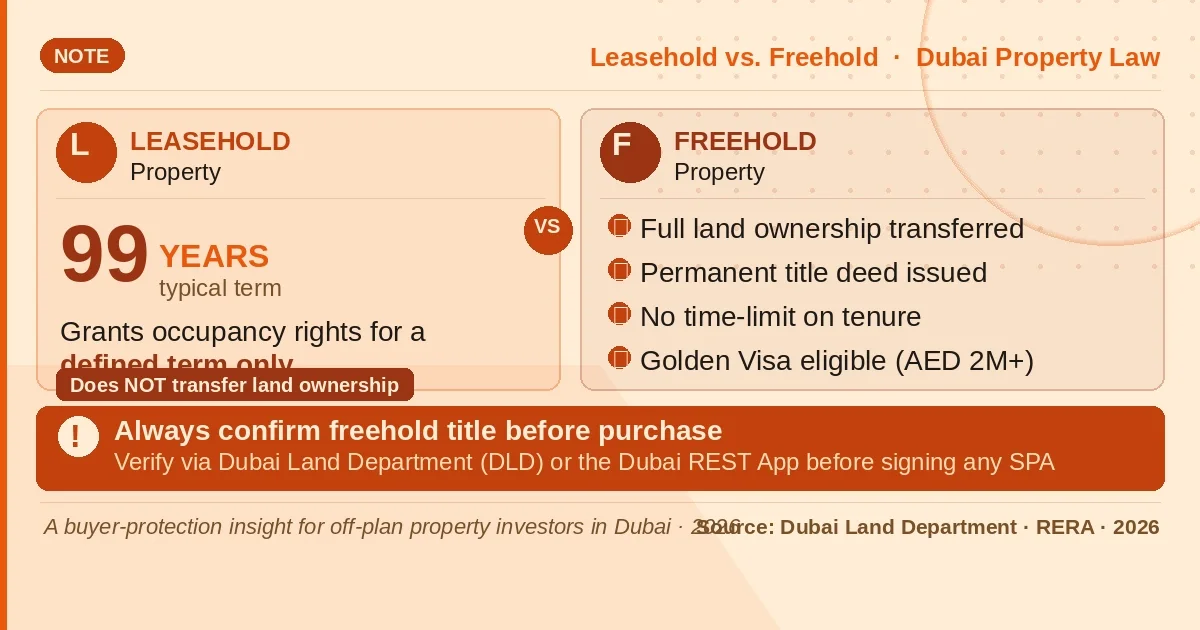
Foreign nationals can only purchase property in designated freehold areas in Dubai. When buying off-plan property in Dubai as a non-UAE national, confirm that the development falls within a freehold zone before proceeding. Key freehold areas include Dubai Marina, Downtown Dubai, Palm Jumeirah, Jumeirah Village Circle (JVC), Dubai Hills Estate, Business Bay, and Arabian Ranches.
If you are targeting UAE Golden Visa eligibility, the property must be valued at a minimum of AED 2 million, and the Oqood registration must be in place before initiating your visa application. The Golden Visa grants a 10-year renewable UAE residency — a powerful incentive that has driven significant demand for premium off-plan units in 2025–2026.
Q9. Off-Plan vs. Ready Property: What Every Buyer Should Weigh Before Buying Off-Plan in Dubai
Off-plan and ready properties serve different investor profiles. Choosing the wrong one for your goals is one of the most common and costly mistakes in the Dubai property investment space.
Off-plan buyers can see capital appreciation of 15–30% by handover in high-demand projects, while ready properties offer immediate rental income with more predictable yields of 6–10% per year. The trade-off is straightforward: off-plan offers higher upside and flexible payments, ready property offers income now and less execution risk.
Off-Plan vs. Ready Property in Dubai — 2026 Comparison
Factor | Off-Plan Property | Ready Property |
|---|---|---|
Entry Price | 10–25% below market value at launch | Market rate — priced on current demand |
Payment Flexibility | Instalment plans over 3–5 years | Full amount or mortgage at purchase |
Immediate Rental Income | None — wait for handover | Yes — rental income from day one |
Capital Appreciation | 15–30% potential by handover in hot areas | Lower upside, more stable value |
Risk Level | Moderate — tied to developer delivery | Low — physical asset already exists |
Resale Timing | Restricted until 30–40% paid | No restrictions, sell anytime |
Golden Visa Eligibility | Yes, if valued at AED 2M+ at Oqood stage | Yes, if valued at AED 2M+ |
Best For | Investors, long-term buyers | End-users, income-seeking investors |
Q10. What Is Your Exit Strategy When Buying Off-Plan Property in Dubai?
Every purchase decision in the Dubai off-plan investment market should begin with a clearly defined exit. The three most common strategies are: (1) flip at 30–50% completion to capture early-stage appreciation before handover; (2) hold and rent post-handover to generate rental yield in Dubai; or (3) long-term hold for capital appreciation aligned with the Dubai 2040 Urban Master Plan.
A widely used strategy is to buy at launch pricing, pay 30–50% of the plan, and then sell the contract to another buyer before handover, capturing price appreciation without ever needing a mortgage. To execute this, ensure the SPA assignment clause permits it and factor in the NOC fee and DLD off-plan registration Dubai costs in your net return calculation.
Conclusion
Buying off-plan property in Dubai can be one of the smartest financial decisions you make in 2026 — but only if you ask the right questions before you sign. The 10 questions in this guide cover every major risk category: developer credibility, legal protections, payment structures, cost exposure, and exit options.
Use the Dubai REST App, verify the RERA escrow account, read every line of the SPA, and consult a RERA-certified broker before committing. The Dubai off-plan property investment market rewards the informed and moves fast against the unprepared.
Ready to invest? Speak to a RERA-certified agent who can verify your chosen project, review the SPA terms, and help you structure a payment plan aligned with your investment goals. |
Frequently Asked Questions
Yes — when done through a RERA-registered developer with an active escrow account and a verified DLD project registration. Dubai’s regulatory framework, anchored by RERA and the DLD, is among the most buyer-protective in the region. Risk increases significantly when buyers skip due diligence on developer track record and escrow verification.
Oqood is the Dubai Land Department’s off-plan property registration system. When you purchase an off-plan unit, your contract is registered in the Oqood system, creating an official legal record of your ownership rights before the title deed is issued at handover. The registration fee is approximately AED 4,000. Without Oqood registration, your purchase is legally unprotected.
Yes. Foreign nationals can purchase off-plan property in designated freehold areas in Dubai with full ownership rights. There is no requirement for UAE residency to buy — though owning a property valued at AED 2M+ can qualify you for the UAE Golden Visa.
Under Dubai law, a developer is granted a standard grace period of 6–12 months beyond the contracted handover date. After this period, delay penalty clauses in the SPA activate. If delays exceed a certain threshold, buyers may be entitled to cancel the contract and claim a refund through the DLD. Document all communications with the developer and retain your Oqood certificate as legal proof.
Use the Dubai REST App (available on iOS and Android) or visit the DLD portal at dubailand.gov.ae. Search the developer’s name under the developer directory. You can also cross-reference their active projects on the RERA project tracker to confirm project status, completion percentage, and escrow account linkage.