
1. Dubai Free Zones Explained: Why They Matter in 2026
Dubai sits at the crossroads of Asia, Europe, and Africa — giving businesses instant access to over 2.5 billion consumers within a 4-hour flight. In 2025–26, Dubai free zones remain the emirate’s most powerful tool for attracting global investment and accelerating economic diversification under the UAE’s long-term vision.
What Is a Dubai Free Zone?
A free zone in Dubai is a designated economic jurisdiction offering 100% foreign ownership, zero corporate and personal tax, and full profit repatriation. Each zone operates under its own regulatory framework, making free zone company formation faster, simpler, and more cost-effective than mainland setup.
There are currently over 30 free zones in Dubai, each designed around specific industries — from fintech and media to logistics and healthcare.
Why Set Up in a Dubai Free Zone?
| Benefit | Detail |
|---|---|
| 🏦 Zero Tax | 0% corporate & personal tax (up to 50 years) |
| 🌍 Full Ownership | 100% foreign ownership, no local sponsor needed |
| 💸 Capital Freedom | Full profit & capital repatriation |
| ⚡ Fast Setup | Streamlined licensing & visa procedures |
| 📦 Prime Location | World-class logistics & digital infrastructure |
For entrepreneurs, startups, and investors, Dubai free zones offer one of the most competitive business environments on the planet — regulated under the Dubai Free Zones Council (DFZC) framework.

2. Understanding Dubai Free Zones: Legal Structure & Key Rules
Dubai free zones are purpose-built economic jurisdictions with their own regulatory authorities, licensing systems, and visa frameworks — all aligned with UAE federal law but designed specifically for international business.
Legal Framework & Governing Authorities
Each free zone in Dubai operates under an independent authority. For example, DMCC governs commodity and trading businesses, while DIFC regulates financial services under a common law framework. These authorities handle licensing, compliance, and visa issuance — giving businesses a streamlined, single-window experience.
Dubai Free Zone vs Mainland vs Offshore
Choosing the right jurisdiction is critical. Here’s a quick comparison:
| Feature | Free Zone | Mainland | Offshore |
|---|---|---|---|
| Ownership | 100% Foreign | 100% Foreign* | 100% Foreign |
| Corporate Tax | 0% (up to 50 yrs) | 9% (above AED 375K) | 0% |
| UAE Market Access | Via distributor | Direct | Not allowed |
| License Types | Trading, Service, Industrial, E-commerce | Commercial, Professional | Holding/Asset |
| Visa Eligibility | Yes (2–10 years) | Yes | No |
*Mainland now allows 100% foreign ownership in most activities following 2021 reforms.
Licenses, Visas & Compliance
Dubai free zones offer four main license types — Trading, Service, Industrial, and E-commerce — depending on your business activity. All free zones enforce KYC norms and annual compliance, maintaining global credibility and investor confidence.
Free zone setups also include residency and investor visas with family sponsorship options, making relocation seamless for entrepreneurs and executives.
💡 Exploring freelance options? Our Dubai Freelance Visa 2026 Guide covers top free zones, eligibility, and full cost breakdowns.
3. Why Choose Dubai Free Zones for Business Setup?
Dubai free zones are purpose-built for global entrepreneurs — combining tax efficiency, world-class infrastructure, and fast-track setup into one powerful package. Here’s why they consistently rank among the world’s top business destinations.
Unbeatable Financial Benefits
The financial case for setting up in a free zone in Dubai is hard to ignore:
- 0% corporate and personal income tax (up to 50 years)
- No import or export duties
- 100% repatriation of capital and profits
- No currency restrictions
These advantages make Dubai free zones significantly more profitable than mainland operations — especially for export-driven and service-based businesses.
Strategic Location & Market Access
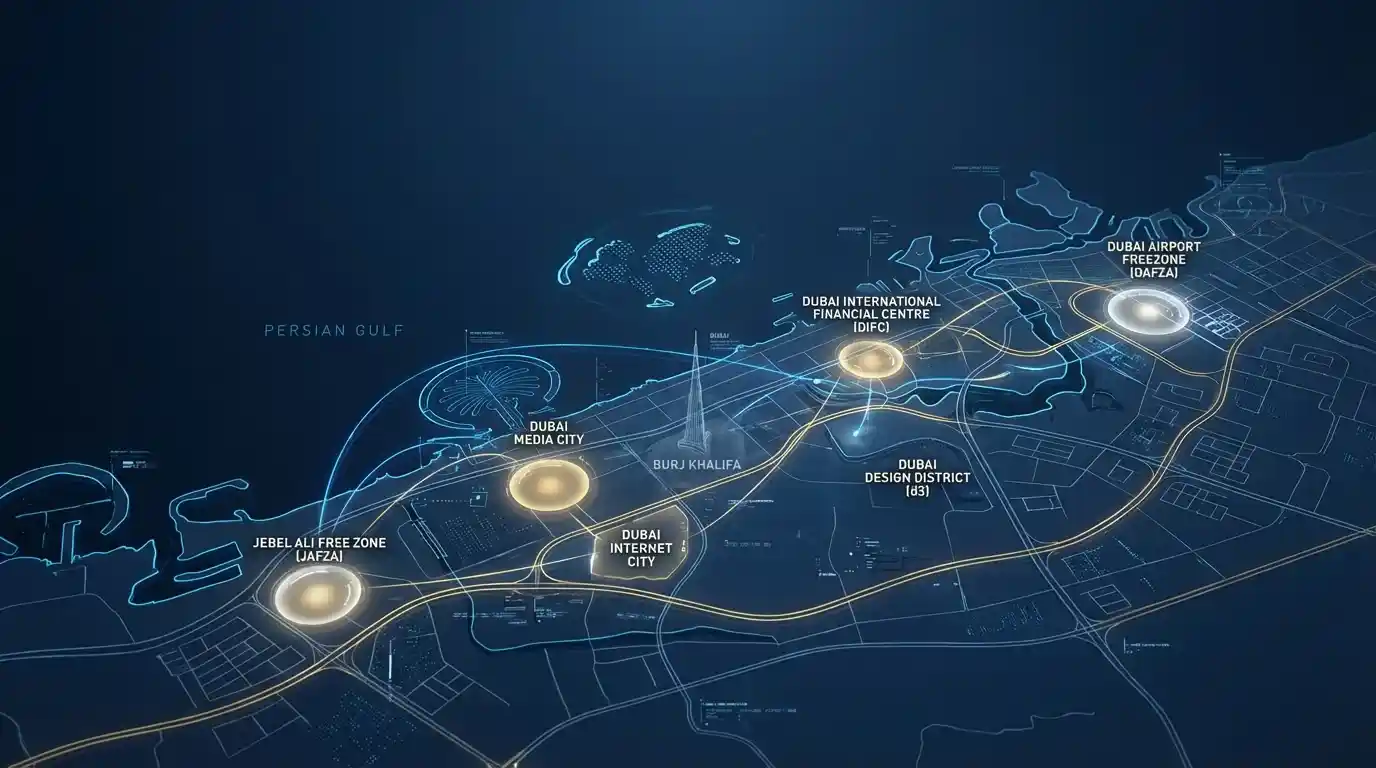
Dubai’s geography is a business asset. Free zones in Dubai connect companies directly to GCC, African, and Asian markets via world-class ports and airports. JAFZA offers unmatched logistics corridors, while Dubai South serves as a dedicated aviation and e-commerce hub — ideal for global supply chains.
Innovation, Community & Workspace
Beyond tax benefits, Dubai free zones offer vibrant business ecosystems. DMCC — voted Global Free Zone of the Year for nine consecutive years by fDi Intelligence — is home to over 24,000 companies across commodities, fintech, and tech sectors.
Entrepreneurs can choose from flexi-desks, serviced offices, warehouses, or innovation hubs — with facilities scaled for both startups and multinational corporations.

4. Top Dubai Free Zones for Business Setup in 2025–26
With over 30 free zones in Dubai, choosing the right one depends on your industry, budget, and growth goals. Below is a curated breakdown of the best-performing Dubai free zones for 2025–26.
1. Dubai Multi Commodities Centre (DMCC)
Best For: Trading, commodities, gold, crypto & fintech
DMCC is the UAE’s largest and most prestigious free zone, consistently ranked Global Free Zone of the Year for nine consecutive years by fDi Intelligence — a record no other free zone in Dubai has matched. Established in 2002, it has grown into a global commodities hub housing over 24,000 companies from 180+ countries.
What Makes DMCC Stand Out?
DMCC operates from Jumeirah Lakes Towers (JLT) — one of Dubai’s most connected business districts — giving companies immediate access to metro links, major highways, and proximity to Dubai Marina and Jebel Ali Port. For businesses in trading, gold, diamonds, energy, and crypto, DMCC offers dedicated commodity exchanges including the Dubai Gold & Commodities Exchange (DGCX) — the region’s largest derivatives exchange.
In 2024, DMCC launched its Web3 and Crypto Centre, positioning itself as the Middle East’s leading hub for blockchain businesses, digital assets, and crypto trading companies — making it one of the most forward-looking Dubai free zones for emerging tech entrepreneurs.
Licensing & Setup:
- Trading, Services, Industrial & Crypto licenses available
- Minimum share capital: AED 50,000 (varies by activity)
- Setup costs start from approximately AED 20,000–50,000 depending on license type and office package
- Over 20 visa allocations available per company depending on office size
Infrastructure & Facilities:
- Premium offices, flexi-desks, serviced offices & warehouse units
- In-house banking facilitation with major UAE banks
- Dedicated compliance and KYC support team
- Access to DMCC’s global business community events and networking
Ideal For: Commodity traders, gold & jewelry businesses, crypto startups, fintech firms, and multinational trading companies looking for a globally credible Dubai free zone base.

2. Dubai Internet City (DIC)
Best For: Tech startups, IT companies, software development & digital media
Established in 2000, Dubai Internet City is the Middle East’s oldest and most influential tech free zone, home to over 2,500 companies including global giants like Microsoft, Google, IBM, and Cisco. For any technology business, a DIC address carries enormous credibility in international markets.
What Sets DIC Apart
DIC sits within TECOM’s interconnected campus alongside Dubai Media City and Dubai Knowledge Park — creating a rare cluster where tech, media, and education businesses naturally converge. In 2024–25, DIC expanded its AI and deep tech accelerator programs, reinforcing Dubai’s push toward becoming a global digital economy leader.
Setup & Key Facts:
- Licenses: IT services, software, e-commerce, digital media & consulting
- Setup costs: from AED 15,000–35,000 depending on package
- Visa allocation: 3–6 visas for entry-level packages, scalable with office size
- Workspace options: flexi-desks, co-working, serviced & dedicated offices
Ideal For: Software firms, IT consultancies, digital agencies, and global tech companies setting up their Middle East HQ in a credible, well-connected Dubai free zone.

3. Jebel Ali Free Zone (JAFZA)
Best For: Logistics, manufacturing, import/export & regional distribution
Established in 1985, JAFZA is the UAE’s oldest and largest free zone, strategically located adjacent to Jebel Ali Port — the world’s 9th busiest port and the largest in the Middle East. This unique positioning makes JAFZA the undisputed choice for businesses built around trade, logistics, and manufacturing in the region.
What Sets JAFZA Apart
JAFZA directly connects businesses to over 140 shipping lines serving 150+ ports globally. Combined with proximity to Al Maktoum International Airport, companies here operate one of the most efficient import-export pipelines in the world. Over 9,500 companies from 100+ countries currently operate within this Dubai free zone — including major players like Unilever, Samsung, and Siemens.
Setup & Key Facts:
- Licenses: Trading, industrial, logistics, manufacturing & services
- Facilities: Warehouses, factory units, open yards & offices
- Zero corporate tax + no import/export duties
- Strategic access to GCC, Africa & South Asian markets
Ideal For: Logistics companies, manufacturers, importers/exporters, and multinationals needing a regional distribution hub within a well-regulated Dubai free zone.
🔗 Visit JAFZA Official Website

4. Dubai International Financial Centre (DIFC)
Best For: Banking, financial services, investment firms & fintech
DIFC is not just a free zone in Dubai — it’s one of the world’s top 10 financial centres, ranked alongside London, New York, and Singapore. Established in 2004, it operates under its own independent common law framework, enforced by the Dubai Financial Services Authority (DFSA) — giving financial businesses the regulatory clarity and international credibility they demand.
What Sets DIFC Apart
DIFC houses over 5,000 companies including global banks, hedge funds, private equity firms, and leading fintech startups. Its legal system — based on English common law — is a major draw for international investors who require familiar, enforceable governance structures. In 2024, DIFC reported a 23% growth in fintech firms, cementing its position as the Middle East’s premier financial innovation hub.
Setup & Key Facts:
- Licenses: Banking, asset management, insurance, fintech & professional services
- Regulated by DFSA — one of the most respected financial regulators globally
- Setup costs: higher than most Dubai free zones, reflecting its premium positioning
- Visa allocation: investor, employment & partner visas available
Ideal For: Banks, investment firms, family offices, wealth managers, and fintech companies requiring a globally recognised, fully regulated Dubai free zone address.

5. Dubai Media City (DMC)
Best For: Media, marketing, advertising, PR & content creation
Launched in 2001, Dubai Media City is the region’s leading media free zone, home to over 2,500 companies including global heavyweights like CNN, BBC, Reuters, MBC, and Publicis. As part of TECOM’s interconnected campus, DMC sits alongside Dubai Internet City and Dubai Knowledge Park — creating a powerful creative-tech-education cluster unique among free zones in Dubai.
What Sets DMC Apart
DMC’s ecosystem goes beyond office space. Its vibrant community drives genuine collaboration between broadcasters, digital agencies, production houses, and marketing firms. In 2024–25, DMC expanded its content creator and influencer licensing options — reflecting Dubai’s rapidly growing digital media economy and positioning itself as the go-to Dubai free zone for modern media businesses.
Setup & Key Facts:
- Licenses: Media, broadcasting, publishing, advertising, PR & digital content
- Workspace: Flexi-desks, co-working spaces, serviced & dedicated offices
- Setup costs: from AED 15,000–30,000 depending on activity and package
- Regular industry networking events, media summits & creative workshops
Ideal For: Media agencies, content creators, production companies, PR firms, and broadcasters looking to establish a credible presence in a thriving Dubai free zone community.

5. Dubai Free Zones vs Mainland vs Offshore: Which Is Right for You?
Choosing between a Dubai free zone, mainland, or offshore setup is one of the most important decisions for any investor. Each jurisdiction serves a different business purpose — here’s a clear breakdown:
Quick Comparison Table
| Feature | Free Zone | Mainland | Offshore |
|---|---|---|---|
| Foreign Ownership | 100% | 100%* | 100% |
| Corporate Tax | 0% (up to 50 yrs) | 9% (above AED 375K) | 0% |
| UAE Market Access | Via distributor | Direct | Not permitted |
| License Types | Trading, Service, Industrial, E-commerce | Commercial, Professional | Holding/Asset |
| Visa Eligibility | Yes (investor & employee) | Yes (broader quotas) | No |
| Setup Cost | Low–Medium | Medium–High | Low |
*Following UAE’s 2021 ownership reforms across most business activities.
Which Should You Choose?
Choose a Dubai free zone if you’re focused on international trade, exports, or a specific industry sector and want maximum tax efficiency with full ownership.
Choose mainland if you need direct access to the UAE local market, want to bid on government contracts, or require broader visa allocations for a larger workforce.
Choose offshore if you need a low-cost holding structure for asset management or international trade — with no requirement for a physical UAE presence.

6. Dubai Free Zone Setup Costs, Licensing & Visa Guide (2026)
Understanding the true cost of Dubai free zone company formation is essential before committing to a jurisdiction. Costs vary by free zone, license type, office package, and visa allocation — but remain significantly more affordable than mainland setups.
Core Cost Components
| Cost Element | Estimated Range (AED) |
|---|---|
| License Fee | 10,000 – 25,000/year |
| Flexi-desk | 10,000 – 15,000/year |
| Private Office | 25,000 – 50,000/year |
| Warehouse | 60,000+/year |
| Investor/Employee Visa | 5,000 – 7,000 per person |
| Dependent Visa | 3,500 – 5,000 per person |
| Annual Renewal | +5–10% of license fee |
Cost by Business Size
- Startups: Flexi-desk + single license — AED 20,000–30,000/year
- SMEs: Private office + multiple visas — AED 50,000–100,000/year
- Large Operations: Warehouse + multiple licenses — AED 150,000+/year
Estimated Costs by Top Dubai Free Zones (2025–26)
| Free Zone | License Type | Office Cost (AED/yr) | Visa Allocation | Est. Total (AED/yr) |
|---|---|---|---|---|
| DMCC | Trading/Service | 25,000–50,000 | 2–5 | 40,000–70,000 |
| DIC | Service/E-commerce | 20,000–40,000 | 2–4 | 35,000–60,000 |
| JAFZA | Industrial/Trading | 30,000–60,000 | 5–10 | 60,000–120,000 |
| DIFC | Financial/Service | 40,000–80,000 | 2–4 | 70,000–120,000 |
| DMC | Media/Service | 20,000–45,000 | 2–5 | 35,000–70,000 |
Key Points on Visas & Compliance
- Visa allocations are determined by office size and license type — not company size
- Most Dubai free zones offer entrepreneur visas with family sponsorship privileges
- Annual license renewal is mandatory — budget for registration fees and compliance audits as additional costs
7. Challenges & Key Considerations Before Setting Up in a Dubai Free Zone
Dubai free zones offer compelling advantages — but a well-informed investor understands the limitations too. Here’s what to consider before committing:
⚠️ UAE Market Access Restrictions
Free zone companies cannot trade directly within the UAE mainland market without appointing a local distributor or agent. If your primary target market is domestic UAE consumers or government contracts, a mainland setup may be more suitable.
⚠️ Industry-Specific Restrictions
Most free zones in Dubai are built around specific sectors. Setting up in the wrong zone can limit your licensed activities, restrict future expansion, and reduce access to relevant industry networks. Always verify that your business activity is permitted under your chosen free zone’s license categories before applying.
⚠️ Compliance & Regulatory Obligations
Operating in a Dubai free zone comes with ongoing compliance requirements — annual license renewals, audited financial statements, KYC documentation, and accurate financial reporting. Non-compliance can result in fines, license suspension, or company deregistration.
⚠️ Hidden & Recurring Costs
Beyond the initial setup, businesses must budget for annual renewals, visa renewals, office lease escalations, and compliance audits. These recurring costs can add 10–20% annually to your base setup cost if not planned for upfront.

8. Dubai Free Zones: Future Outlook & Investment Opportunities in 2025–26
Dubai free zones are entering a high-growth phase, backed by government policy, smart city investment, and surging global demand for UAE-based business hubs. Here’s where the real opportunities lie:
🚀 High-Growth Sectors to Watch
Technology & AI Dubai Internet City and Dubai Silicon Oasis continue attracting global tech giants and AI startups, supported by the UAE’s national AI Strategy 2031 — which directly channels investment into free zones in Dubai focused on emerging technologies.
E-Commerce & Logistics Dubai CommerCity — the region’s first dedicated e-commerce free zone — and Dubai South are capitalising on the UAE’s booming online retail market, projected to exceed $8 billion by 2026. Their integrated warehousing and last-mile delivery infrastructure makes them standout Dubai free zones for digital commerce businesses.
Financial Services & Fintech DIFC recorded a 23% growth in fintech firms in 2024, reinforcing its status as the Middle East’s premier financial hub. Expect continued expansion in digital banking, crypto regulation, and Islamic fintech throughout 2025–26.
🏙️ Smart City Integration
Dubai is actively embedding free zones into its broader smart city infrastructure — deploying AI-driven licensing systems, blockchain-based compliance tools, and digital visa processing. This reduces setup timelines and operational costs, making Dubai free zone company formation faster and more efficient than ever.
📈 Key Trends for 2025–26
- Rising demand for sector-specific free zones catering to niche industries
- Increased foreign direct investment (FDI) inflows driven by UAE’s competitive tax framework
- Growth in Golden Visa eligibility linked to free zone investments
- Expansion of virtual/flexi-license options for remote entrepreneurs
💡 Investor insight: The combination of zero tax, 100% ownership, and smart infrastructure makes Dubai free zones one of the highest-ROI business environments globally — and 2025–26 is shaping up to be a landmark year for new entrants.
9. Conclusion: Is a Dubai Free Zone Right for You in 2025–26?
Dubai free zones offer an unbeatable combination — 100% foreign ownership, zero corporate tax, streamlined licensing, and global market access. Whether you’re a startup, SME, or multinational, the right free zone in Dubai can significantly reduce costs and accelerate growth.
With over 30 free zones in Dubai available, choosing the right one depends on your industry, budget, and target market. The wrong choice can mean restricted activities and missed opportunities.
🏠 How Map Homes Real Estate Can Help
At Map Homes Real Estate, we help investors find premium commercial and office spaces across Dubai’s top free zones — aligned with your business goals and budget.
Ready to get started?
- ✅ Schedule a free consultation
- ✅ Explore offices across top Dubai free zones
- ✅ Get expert guidance on company formation
Frequently Asked Questions
Dubai currently has over 30 dedicated free zones, each governed by its own regulatory authority and designed for specific industries — from finance and technology to logistics, media, and healthcare.
IFZA (International Free Zone Authority) and RAKEZ are among the most affordable options, with licenses starting from around AED 12,900–15,000 per year, making them popular choices for startups and solo entrepreneurs entering the UAE market.
Yes —, Dubai’s Executive Council Resolution No. 11 allows free zone companies to operate in the mainland by obtaining a permit from the Department of Economy and Tourism (DET), without needing to set up a separate mainland entity.
A free zone company offers 100% foreign ownership and 0% corporate tax but was traditionally restricted to international trade. A mainland company allows direct access to the UAE domestic market and government contracts but is subject to 9% corporate tax on profits above AED 375,000.
Free zone companies that qualify as a “Qualified Free Zone Person (QFZP)” and meet substance requirements continue to enjoy a 0% corporate tax rate. However, income from mainland UAE operations is taxed at the standard 9% rate.
DMCC, Dubai Internet City, and IFZA are consistently top-rated for startups due to their flexible licensing, affordable packages, strong business communities, and access to investor networks and accelerator programs.
Yes, free zone companies can sponsor residency visas for owners, employees, and their dependents. The number of visas allocated depends on the office package — typically 2–6 visas for entry-level packages, scalable with office size.
No — most free zones in Dubai offer flexi-desk and virtual office options as a registered business address, making it possible to set up a fully compliant company without leasing a dedicated physical office space.