
Introduction: Is Dubai Property Investment Still Worth It in 2026?
Dubai property investment remains worth serious consideration — even after the most dramatic week in the Gulf’s recent memory.
On February 28, 2026, US and Israeli coordinated strikes on Iran killed Supreme Leader Ali Khamenei, targeting its leadership, nuclear programme, and missile infrastructure. Iran retaliated fast — launching strikes across the Gulf, hitting Bahrain and the UAE. Dubai wasn’t spared; debris from Iranian drones struck Dubai International Airport, the Burj Al Arab, and Palm Jumeirah, triggering flight suspensions.
And yet, capital continues flowing into Dubai. From the 2006 Lebanon War to the 2019–2020 Gulf tensions, Dubai property investment has consistently proven its resilience. Experts see the current slowdown as a strategic entry window — not an exit signal.
This article delivers hard comparisons with Tehran, Tel Aviv, and Beirut; data behind Dubai real estate during the Iran conflict 2026; and why Dubai property investment remains the safest bet in the Middle East.
What Actually Happened in Late February–Early March 2026?
The headlines this week have been anything but ordinary.
Here’s the hard, unfiltered timeline every investor in the Gulf needs to understand right now:
📅 February 28, 2026 — The Strikes Begin
The United States and Israel launched coordinated strikes on Iran, targeting its nuclear infrastructure, missile sites, and military leadership. The operation killed Supreme Leader Ali Khamenei — a seismic event that sent shockwaves across the entire Middle East geopolitical landscape.
📅 March 1, 2026 — Iran Strikes Back
Iran’s retaliation was swift and wide. Tehran fired 137 missiles and 209 drones across the UAE alone, with fires and smoke reaching Dubai landmarks including Palm Jumeirah and Burj Al Arab. Dubai International Airport — the world’s busiest for international traffic — was hit, as was Kuwait’s airport. (CNN)
This wasn’t a surgical strike on a single US base. Iran launched indiscriminate missile and drone attacks against sovereign territories across the region, targeting the UAE, Bahrain, Jordan, Kuwait, Oman, Qatar, Saudi Arabia, and Iraq — all within 24 hours.
“For the first time in history, all GCC states were targeted by the same actor within 24 hours. Their long-standing nightmare scenario has happened,” said Sinem Cengiz, researcher at Qatar University’s Gulf Studies Center.
📅 March 2–3, 2026 — Ongoing Escalation
Loud explosions continued through Dubai for a third consecutive day of Iranian retaliatory strikes, with sirens also heard in Kuwait and reports of further blasts in Manama. (The Washington Post)
As of today — March 3, 2026— the conflict shows no sign of an immediate ceasefire.
What Investors Are Actually Worried About Right Now
Search volumes for terms like “is Dubai property still safe“ and “impact of Iran Israel war on Dubai real estate“ have spiked sharply this week. The anxieties are real and understandable:
- War spill-over — Will the conflict spread further into the UAE?
- Oil supply shocks — Saudi Aramco shut down the Ras Tanura refinery after a drone strike, causing a blaze at one of the world’s largest oil facilities. Energy markets are rattled.
- Sanctions risk — Could secondary sanctions create capital flow restrictions in and out of Dubai?
- Safe haven narrative — Iran’s strikes have shaken the Gulf region’s image of stability and safety, which had helped it cultivate investment, draw in expatriates, and attract tourism. Council on Foreign Relations
The media isn’t pulling punches either. Fortune called it “Dubai’s ultimate nightmare, as its very essence depended on being a safe oasis in a troubled region.”
That’s the context. Now — does the data actually support that narrative? That’s exactly what the rest of this article unpacks.
Is Dubai Property Investment Still Safe After the 2026 Iran Strikes?
The short answer: Yes — Dubai property investment is still considered safe, especially when you measure it against the realistic alternatives.
Despite Iran’s March 1 attacks, three structural pillars keep Dubai property investment firmly intact: proven security infrastructure that intercepted most projectiles, a politically neutral government, and an economy diversified well beyond oil. These are exactly why capital has historically moved into Dubai during crises, not out of it.
That said, the anxiety is legitimate — “Is Dubai real estate safe after Iran missile attacks?” is one of the most searched real estate questions this week, and honest dubai property investment analysis can’t ignore that.
But here’s the critical framing: safety is always relative.
City | Under Active Attack? | Property Market Status | Investor Access |
Tehran | War epicentre | Functionally closed to foreign investors | Severe restrictions |
Tel Aviv | Ongoing conflict zone | High volatility, insurance collapse | Near-inaccessible |
Beirut | Unstable post-war | Decades of currency and title risk | Extremely high risk |
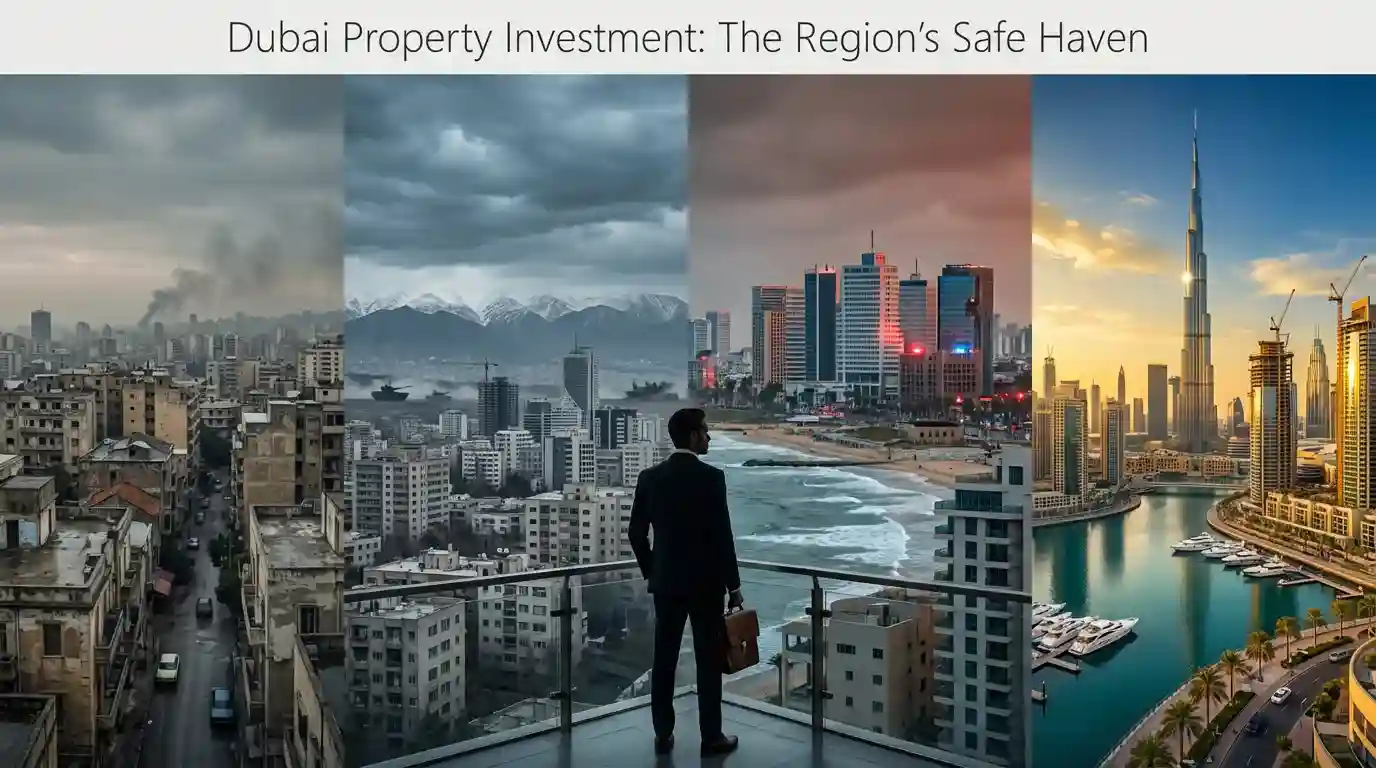
Dubai | Struck, but operational | Paused — not in retreat | Open, liquid, functioning |
So far, tremors have been muted — no broad sell-off, no rush for the exits. That’s not spin; that’s the market speaking.
Experienced investors are treating this as a strategic entry window, using lower competition to secure premium assets while UAE fundamentals remain stable. A sophisticated definition of a safe haven isn’t a location isolated from its geography — it’s a jurisdiction equipped to neutralise external variables. Dubai has demonstrated exactly that, in real time.
Should you delay Dubai property investment because of the 2026 strikes? Experts suggest the market is more likely to moderate than collapse — a sustained price drop would require broader, prolonged regional escalation, not a single week of headlines.
The Dubai property investment safe haven narrative isn’t dead. It’s being stress-tested — and early evidence suggests it’s holding.
Historical Pattern: How Dubai Property Investment Performs During Middle East Crises
If you want to predict how a market behaves tomorrow, study how it’s behaved under pressure before.
Dubai property investment doesn’t just claim safe haven status — it has earned it, crisis by crisis, decade by decade.
A Track Record Built on Turbulent Times
The emirate benefited significantly during the Iran–Iraq War, the Gulf War, and most recently the Russia–Ukraine conflict, which saw Russian buyers become the top investors in Dubai’s luxury real estate market in 2022. During the Russia–Ukraine crisis alone, prices in Dubai’s prime areas surged by 44%, driven by high-net-worth individuals seeking security and stability.
This is the pattern: regional chaos → capital flight → Dubai as the landing pad.
Crisis | Period | Dubai Market Reaction |
Iran–Iraq War | 1980–1988 | Capital inflows from both Iranian and Arab investors |
Gulf War | 1990–1991 | Temporary pause, strong recovery post-conflict |
9/11 & regional fallout | 2001–2002 | Short dip, followed by one of Dubai’s strongest growth runs |
Arab Spring | 2010–2012 | Dubai prices rose as capital fled Egypt, Libya, Syria |
Russia–Ukraine War | 2022 | Prime prices surged 44%; Russian buyers led luxury segment |
Israel–Iran tensions (2025) | Mid-2025 | HNW enquiries from Middle Eastern buyers rose 30–40%, with capital redirecting from conflict-prone countries into Dubai’s luxury residential and commercial segments |
The “Flight to Safety” Mechanism — How It Actually Works
When a regional crisis erupts, investors don’t park their money under a mattress. They look for the nearest liquid, stable, internationally recognised real estate market. In the Middle East, that has consistently been Dubai.
The demand mix is what makes Dubai’s resilience so durable:
- Local end-users — Emirati families and long-term UAE residents don’t panic-sell
- Expat investors — Hold for yield; short-term noise rarely triggers exit decisions
- International capital — The classic “Dubai hedge” play: when the region looks risky, Dubai looks relatively safer
This trend of capital flight from Iran and Israel into Dubai real estate isn’t new — GCC institutional investors and family offices are not pulling back. Instead, many are realigning their strategies to prioritise low-risk, high-return locations within the UAE, especially Dubai.
Where Dubai Stands Today Going Into 2026
The Dubai Land Department reported a record-breaking January 2026, with residential transactions surging 43.9% year-on-year to AED 55.18 billion across 15,756 sales — entering this crisis from a position of exceptional market strength.
In 2025, Dubai recorded over 215,000 real estate transactions worth approximately $187 billion, driven by luxury demand and foreign buyers from India, Russia, Ukraine, Pakistan, and Afghanistan. That’s not a fragile market — that’s a well-capitalised one with deep demand roots, exactly the kind that weathers storms rather than capsizing in them.
For Dubai property investment, the old saying has never been more relevant: the time to buy is when there’s blood on the streets — not after everyone else has figured out the danger has passed.
Dubai vs Tehran, Tel Aviv and Beirut — Which Market Is Really Safer?
Ask any seasoned investor “how safe is Dubai compared to Tehran, Tel Aviv and Beirut for real estate investors in 2026?” and the honest answer isn’t even close.
Tehran is not a viable destination for most international investors — full stop. Foreigners cannot purchase property freely, requiring government authorisation that varies by nationality and diplomatic relations. The process is slow and opaque. Layer on 40–45% inflation, severe dollar conversion risk, and sanctions-driven banking restrictions that can trap capital inside the country — and you’re not looking at an investment, you’re looking at a gamble.
Compared to Dubai property investment, Tehran offers no legal transparency, no reliable exit strategy, and no currency protection. The contrast couldn’t be starker.
Tel Aviv has a sophisticated property market — but it’s now directly on the front line. In 2025, housing prices rose just 0.4% nationally, with Tel Aviv itself down 1.9%, and some neighbourhoods seeing 15–20% price drops. A strong economy, yes — but a market where missile sirens influence buying decisions is no substitute for Dubai property investment right now.
Beirut carries wounds that predate this crisis. Since 2019, Lebanon’s currency has lost over 95% of its value, its banking sector collapsed, and the country defaulted on $29 billion in Eurobonds. Apartments still sit 20–30% below pre-2019 levels. Recovery is possible — but remains hostage to political reform that has been promised and never delivered.
Dubai property investment operates in an entirely different league. 100% freehold foreign ownership, a dollar-pegged currency, zero income and capital gains tax, and a transparent digital title system — all within a politically neutral jurisdiction. That’s the structural foundation that makes Dubai property investment a genuine safe haven while regional peers remain trapped in their own crises.
The Three Pillars Making Dubai Property Investment a Regional Safe Haven
Pillar 1 — Security Architecture & GCC Defense
When Iran launched its March 1 barrage, the UAE didn’t just survive — it demonstrated why its security infrastructure commands global respect. Over 700 missiles and drones were launched in the first two days — more than Tehran fired at Israel — yet only three lives were lost. That’s not luck. That’s engineering.
The UAE operates a multi-layered defence architecture combining Patriot PAC-3, THAAD, NASAMS, and Barak-8 systems, achieving a 95% missile and 94% drone interception rate — rivalling Israel’s Iron Dome.
Within 48 hours, Dubai’s financial institutions resumed remote operations and the DIFC activated emergency continuity protocols — proving that disruption was managed, not chaotic.
For Dubai property investment, this matters. Resilience amid Middle East tensions isn’t a marketing phrase — it’s the result of a state that has invested billions ensuring life and commerce continue, even under fire.
Pillar 2 — Legal Framework, Ownership Rights & Tax Advantages
Dubai property investment sits on one of the most investor-friendly legal foundations in the world — and that foundation didn’t shake during this week’s events.
Key advantages that remain fully intact:
- 100% freehold ownership — No government approval required for foreign buyers in designated freehold areas; no local partner needed; title deeds issued digitally by the Dubai Land Department.
- Zero personal income tax and no capital gains tax — your returns stay yours, in full
- Dollar-pegged currency — the AED’s peg to the USD eliminates currency risk entirely, a stark contrast to Tehran’s collapsing rial
- Residency through property — investors purchasing AED 2 million (approximately $545,000) or more qualify for the Dubai Golden Visa: a 10-year renewable residency that covers the investor, their spouse, children of any age, and parents
- Entry-level residency — a 2-year investor visa is available from AED 750,000, making the Dubai residency by investment pathway accessible at multiple budget levels
Recent 2025 updates strengthened digital title deeds, escrow protections, and RERA oversight — reinforcing an already transparent legal environment. In a region where property laws are opaque and currencies evaporate overnight, this rules-based system is a Dubai property investment advantage that compounds over time.
Pillar 3 — Economic Diversification & Real End-User Demand
Dubai’s property market is supported by an economy that has long moved past oil dependency — a crucial buffer when energy markets face shocks.
Over 95% of Dubai’s GDP now comes from non-oil sectors, with GDP growing 4.4%in the first half of 2025 toAED 241 billion— driven by financial services, logistics, tourism, and technology. (UAE Ministry of Foreign Affairs)
The demand pillars that underpin Dubai property market stability in 2026:
- Population growth — Dubai’s population is projected to exceed 5 million by 2030, creating structural housing demand
- Tourism — nearly 20 million tourists visited Dubai in 2025, with the aviation sector alone accounting for 27% of GDP
- Genuine end-user demand — long-term expat residents, multinational company employees, and regional professionals buying for lifestyle, not just speculation
- Connectivity — Dubai International Airport handles over 88 million passengers annually, keeping the city firmly plugged into global capital flows
This diversity of demand is what separates Dubai’s real estate market from purely speculative ones. When tourism softens, financial services pick up. When trade volumes dip, tech and fintech expand the base. The D33 agenda — Dubai’s roadmap to double its economy by 2033 — keeps long-term infrastructure investment locked in regardless of short-term regional turbulence.
An economy this diversified doesn’t collapse from a single week of geopolitical noise. It absorbs it.
What the Numbers Say About Dubai Property Investment in 2026
Numbers don’t lie — and right now, they’re telling a story that runs counter to the panic headlines.
Pre-crisis, Dubai’s market was running red hot:
- In January 2026 alone, total transaction values hit AED 107.96 billion — an 86.5% jump from January 2025, with 21,884 transactions recorded, up 17.3% year-on-year
- Between 2020 and 2025, transactions rose 521%, total market value climbed 860%, and average price per square foot grew 80.5% — a sustained multi-year upcycle, not a speculative bubble
- Average residential prices rose from AED 1,484 per sq ft to AED 1,676 per sq ft across 2025, with annual values sitting approximately 13% higher year-on-year heading into the crisis
Post-March 1 attacks — what the market is signalling:
The crucial early signal isn’t a price crash — because there hasn’t been one. No mass sell-off, no distressed listings. Just a pause in momentum, not a reversal. Around 70% of surveyed buyers still plan to purchase within six months — reflecting conviction that no single week of headlines can dislodge.
This is exactly how Dubai property investment behaves under pressure — it hesitates, it doesn’t collapse.
The flight-to-safety mechanism is already in motion. High-net-worth inflows rose 46% year-on-year in 2025, with USD 63 billion in incoming wealth from conflict-affected jurisdictions including Iran, Israel, Lebanon, Russia, and Ukraine. As the Israel–Iran conflict deepens, that same mechanism is expected to accelerate through Q1–Q2 2026 — with capital from conflict zones gravitating toward a dollar-pegged, rule-of-law market.
Dubai Property Investment Intelligence
Interactive Safe Haven Data Report · March 2026
How Investors Can Build a ‘Dubai Hedge’ in 2026
8.1 What a “Dubai Hedge” Actually Looks Like
Every regional investor with political risk exposure needs to understand one concept: the Dubai hedge — using Dubai property investment as a direct counterbalance to geopolitical instability elsewhere.
When your home market faces sanctions or currency collapse, a dollar-pegged Dubai asset doesn’t just hold value — it appreciates relative to your losses. Iran, Russia, Ukraine, and Lebanon have all proven this, repeatedly.
For high-net-worth individuals, Dubai property investment is a strategic asset class — offering 0% capital gains tax, USD-pegged stability, and sovereign risk protection.
Building the hedge intelligently means diversifying within Dubai, not just into it:
Strategy Layer | Location Focus | Profile |
Capital preservation | Palm Jumeirah, Emirates Hills, Downtown | HNWI, ultra-luxury, long hold |
Yield + stability | Dubai Marina, Business Bay, JVC | Balanced investor, rental income |
Growth play | Dubai Creek Harbour, Dubai South | Patient capital, 3–5 year horizon |
Entry-level hedge | JVC, Arjan, Jumeirah Village Triangle | First-time investors, AED 750K+ |
Sophisticated buyers in 2026 are using corporate structures and off-plan payment plans to acquire prime assets in Dubai Hills Estate, Emirates Hills, and Palm Jumeirah — as capital preservation vehicles, not lifestyle purchases.
No other regional city offers Dubai property investment’s combination of liquidity, legal clarity, tax efficiency, and residency access under one roof. The Dubai Golden Visa adds a further dimension — invest AED 2 million+ for a 10-year renewable residency covering the investor, spouse, children, and parents. In a region at war, that’s genuinely life-altering.
8.2 End-User vs. Pure Investor — Why the Distinction Matters
Here’s something most headlines miss: Dubai’s property market is not driven by speculators. It is anchored by a large and growing base of end-users — people who live, work, and raise families here.
Corporate relocations and state-level investments — including Microsoft’s planned $7.9 billion commitment between 2026 and 2029 — are creating sustained demand for executive housing driven by genuine population growth, not just investor appetite.
This matters enormously for crisis resilience:
- End-users don’t panic-sell when geopolitical headlines worsen — they need somewhere to live
- Rental demand stays firm because expat employment continues regardless of regional tensions
- Vacancy rates stay low, protecting yields even when transaction volumes pause temporarily
- Price floors hold because genuine occupiers compete for limited well-located stock
Prime communities are delivering net rental yields of 5–6.5% — globally competitive figures that provide reliable income even as capital appreciation normalises.
This end-user base is Dubai property investment’s invisible shock absorber — separating a temporary sentiment dip from a structural correction. As long as Dubai’s population keeps growing, the floor holds firm.
Crisis-proof living isn’t a marketing slogan. It’s an architectural feature of how Dubai’s property market is built.
Why Dubai Property Investment Still Makes Sense in a War Zone Region
Even after the February 28 US–Israel strikes on Iran, the killing of Supreme Leader Ali Khamenei, and Iran’s March 1 attacks on GCC nations including Dubai, the structural case for Dubai property investment hasn’t just survived — it’s been reinforced. Capital is escaping to Dubai, not from it.
The three pillars remain standing: battle-tested security infrastructure, an unmatched legal and tax environment, and a diversified economy anchored by real end-user demand. No regional competitor comes close.
Think in years, not news cycles. Every crisis this city has faced has ultimately sent its property market higher. Dubai isn’t just weathering this storm — it’s cementing its position as the new capital of certaintyfor global wealth.
For investors ready to act strategically, the team at Map Homes Real Estate can help you identify the right asset, at the right entry point, with the right long-term positioning.
The safest place to invest in property in the Middle East isn’t a debate anymore. The numbers have already answered it.
Frequently Asked Questions
Yes — Dubai property investment remains fundamentally sound despite Iran’s March 1 strikes. Experts confirm that zero personal income tax, world-class infrastructure, and Dubai’s role as the region’s aviation and trade hub remain fully intact.
Most experts say the market is more likely to moderate than collapse, with the ultra-luxury segment — homes priced above AED 10 million — remaining particularly resilient, recording 990 transactions in January 2026 alone.
Investment advisors say that capital at the high-net-worth level tracks governance strength, tax efficiency, and policy stability — and that seasoned investors often see post-crisis moments as entry points, not exit signals.
Prior to the strikes, the UAE was on track to attract a record 9,800 relocating millionaires in 2025 — more than any other country on earth — with capital from conflict-affected regions consistently flowing into Dubai’s property market. Even billionaire Elon Musk reaffirmed confidence in the city post-strikes, stating on X that “Dubai and UAE broadly are objectively safer and better run than many areas of Europe.”
According to real estate strategists, geopolitical events typically create a 48 to 72 hour pause in transaction activity — experienced investors use this window to secure premium assets at lower competition, not to exit. The effect of US–Israel strikes on Iran on Dubai property is a short-term sentiment dip, not a long-term valuation shift. Investors who waited during the Arab Spring and the Russia–Ukraine war consistently missed the best entry points.