


1. Introduction to Dubai Rental Yield Mistakes
Rental yield in Dubai is the annual rental income expressed as a percentage of the property’s purchase price — gross rental yield ignores costs, while net rental yield in Dubai accounts for service charges, maintenance, and vacancy periods. Despite Dubai rental yields averaging 6–9%, many investors quietly bleed returns through avoidable errors. The biggest killers? High service charges on Dubai apartments, poor tenant retention, underestimating maintenance costs, and a flawed pricing strategy — all classic factors affecting rental yield in Dubai that erode cash flow faster than you’d expect.
This guide covers the top 10 rental yield Dubai mistakes and exactly how smart investors protect and grow returns on their Dubai buy to let properties.
2. What Is a “Good” Rental Yield in Dubai in 2026?
A good rental yield in Dubai typically ranges between 6% and 10%, depending on the community, property type, and management quality — well above the global average of 3–4%. In the Dubai property market 2026, high-performers like Jumeirah Village Circle, Dubai Silicon Oasis, and International City consistently deliver strong numbers.
But here’s where most landlords get it wrong: they confuse gross vs net rental yield in Dubai.
- Gross yield = annual rent ÷ purchase price × 100
- Net rental yield Dubai = factors in service charges, maintenance, vacancy, and mortgage costs — and can be 2–3% lower
Rental income vs purchase price in Dubai looks attractive on paper. But Dubai rental yields shrink fast once real costs hit.
(A detailed comparison table of gross vs net yields by community is covered ahead.)
3. Factor #1: Service Charges That Eat Your Net Yield
Service charges are the silent assassin of Dubai rental yields. Many investors fall in love with a gross yield number — only to watch it collapse once service charges on Dubai apartments hit the books.
In luxury towers, annual service charges can run AED 25–45 per sq ft, and that’s before cooling charges and chiller fees in Dubai — which can add AED 6,000–15,000 per year depending on usage. Service charge-heavy luxury towers in Dubai often deliver net yields 2–3% below their advertised gross figures.
Budget communities, on the other hand, frequently offer higher net yields precisely because service charges sit in the AED 8–15 per sq ft range.
Quick comparison:
Property Type | Gross Yield | Annual Service Charge | Net Yield (Est.) |
Luxury Tower (Downtown) | 6.5% | AED 40/sq ft | ~4.2% |
Mid-Market (JVC) | 6.8% | AED 12/sq ft | ~5.9% |
Always stress-test your rental yield in Dubai with realistic service charge assumptions — not developer estimates. The impact of Dubai service charges on ROI is where many landlords quietly lose the yield war.
4. Factor #2: Vacancy Risks and Overestimating Occupancy
Hope is not a strategy — yet most Dubai landlords build their ROI calculations on 100% occupancy. That’s a costly assumption.
Vacancy rate in Dubai rentals varies significantly by community, property type, and season. Even in strong markets, a realistic buffer of 1–2 vacant months per year is prudent. Here’s how that dents your returns:
Vacancy Period | Effective Annual Rent (AED 80,000/yr) | Yield Impact |
0 months | AED 80,000 | Full yield |
1 month vacant | AED 73,333 | -8.3% income loss |
2 months vacant | AED 66,667 | -16.7% income loss |
Rental vacancy risk in Dubai is higher in oversupplied pockets and ultra-luxury segments. Short-term vs long-term rentals in Dubai also carry different vacancy profiles — holiday homes face seasonal dips while long-term leases offer stability.
Smart investors cross-check expectations against the Dubai Rental Index (RERA) and live market data — not developer projections. Strong tenant retention in Dubai rentals through competitive pricing and responsive management is ultimately the cheapest vacancy cure.
5. Factor #3: Wrong Pricing Strategy – Overpricing or Underpricing the Rent
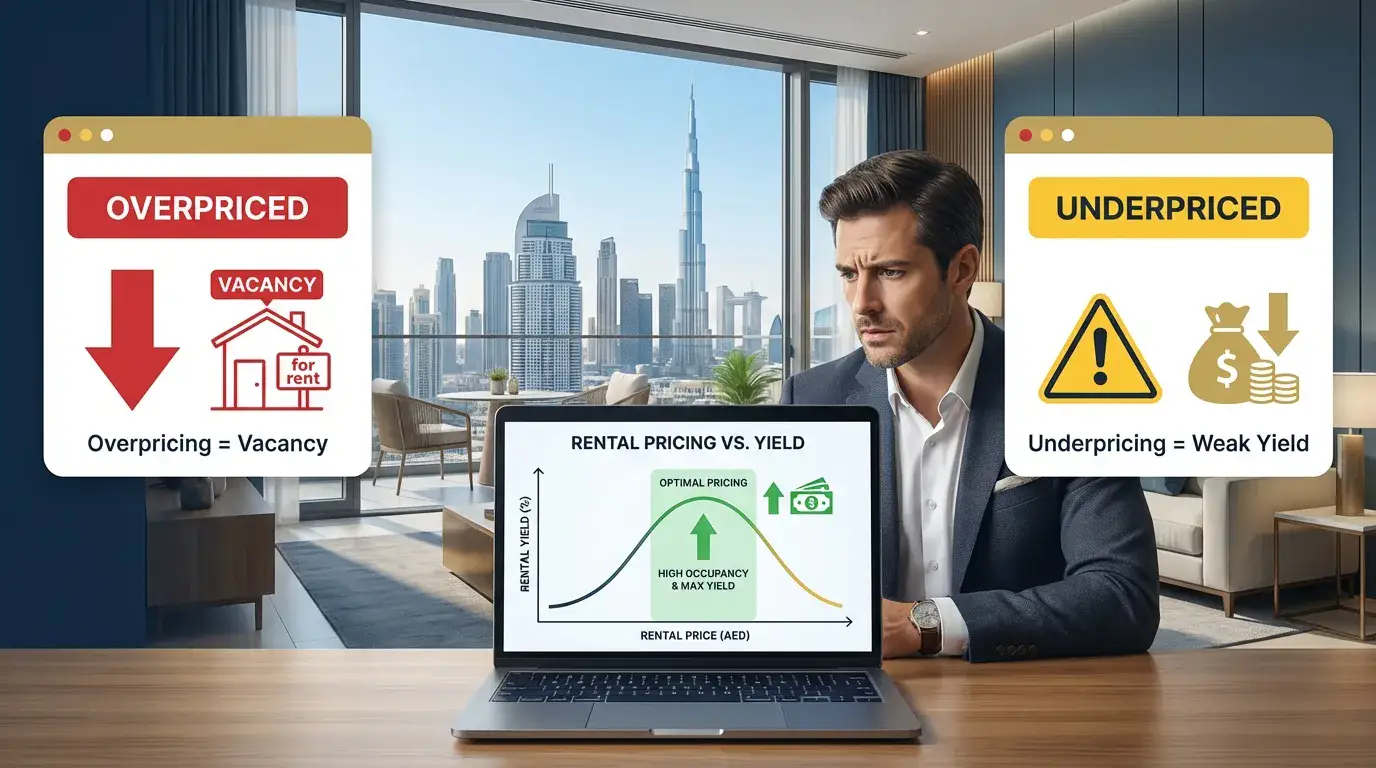
Price it wrong and you lose — either way.
Overpricing rent in Dubai is the fastest route to extended vacancy. Tenants today are informed — they cross-check listings instantly. An overpriced unit sits empty, accumulates carrying costs, and eventually rents below market after heavy negotiation anyway. Net result: lower cash flow than if it were priced right from day one.
Underpricing rent in Dubai is equally damaging — it locks in weak yields, attracts cost-sensitive tenants with higher turnover, and is difficult to reverse mid-tenancy under RERA regulations.
The fix? Use the Dubai Rental Index (RERA) and Dubai rental yields by community data to anchor your pricing. Communities like Jumeirah Village Circle, Dubai Silicon Oasis, and Arjan consistently rank among those with the highest rental yield in Dubai — but only when priced within active tenant demand bands.
A sharp rental price strategy for Dubai landlords balances maximum achievable rent with minimum vacancy risk.
6. Factor #4: Underestimating Maintenance, Capex, and Property Condition
What you don’t budget for will budget you out of profit.
Maintenance costs on Dubai property are routinely underestimated — especially in buildings over 10 years old. Beyond routine fixes, smart investors must account for capex on Dubai investment property: AC unit replacements (AED 3,000–8,000), kitchen refurbishments, bathroom upgrades, and periodic repainting between tenancies.
Property conditions directly drive rental demand in Dubai. A well-maintained unit commands premium rent and retains tenants longer. A neglected one triggers vacancy cycles and price concessions.
Key considerations for risk management for Dubai landlords:
- Furnished vs unfurnished rental in Dubai — furnished units command 15–20% higher rent but carry higher furniture replacement costs
- Older buildings carry hidden capex that erodes net rental yield Dubai faster than anticipated
- Investment property due diligence in Dubai must include a building condition assessment (Property Finder Maintenance Cost Guide), not just a yield calculation
Budget at least 1–1.5% of property value annually for maintenance and capex reserves.
7. Factor #5: Financing & Mortgage Costs Eating Cash Flow
A positive gross yield can turn cash-flow negative overnight once mortgage costs enter the equation. Yet this remains one of the most overlooked mistakes in Dubai buy to let strategy.
Here’s the reality: interest rates for Dubai property investors on variable-rate mortgages have hovered between 4.5–6% in recent years. On a 75% LTV mortgage, those financing costs can consume half or more of your gross rental income — leaving net returns razor-thin or negative.
Common mistakes include:
- Ignoring mortgage processing fees (typically 0.25–1% of loan value)
- Not stress-testing rental yield in Dubai under rising rate scenarios
- Overestimating rental income to justify an aggressive loan-to-value
The mortgage impact on rental yield in Dubai is straightforward math — but investors chasing “cheap” finance often skip it. Always model your Dubai real estate ROI at multiple interest rate points before committing. If the numbers only work at the lowest possible rate, the deal doesn’t work.
8. Factor #6: Poor Tenant Profile and Weak Retention
In Dubai’s rental market, tenant quality and yield stability go hand in hand. A bad tenant doesn’t just cause headaches — they destroy returns through late payments, property damage, and costly churn cycles that feed directly into vacancy periods and inflated maintenance bills.
Dubai landlords who prioritize filling a unit fast over screening tenants properly pay for it later — repeatedly.
Smart risk management for Dubai landlords means:
- Thorough tenant screening (employment verification, tenancy history)
- Competitive but firm lease terms to reduce turnover
- Responsive property management quality in Dubai that keeps good tenants renewing
Tenant retention in Dubai rentals is cheaper than re-letting. Every lease renewal avoided is a vacancy, an agent fee, and a repainting job saved.
9. Factor #7: Misusing Short-Term Rentals & Holiday Homes
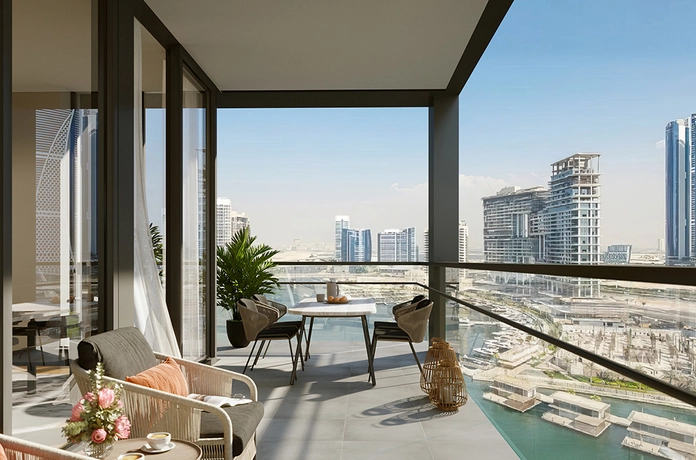
Holiday home yields in Dubai look irresistible on paper — nightly rates in prime areas can fetch 2–3x equivalent long-term rents. But the devil is in the details.
Many investors jump into short-term rentals without accounting for:
- DTCM licensing fees and compliance requirements
- Platform commissions (typically 15–25% of revenue)
- Higher housekeeping, utility, and furnishing costs
- Seasonal vacancy dips — Dubai’s summer slowdown is real
When you run the full numbers, short-term vs long-term rentals in Dubai often deliver comparable — sometimes inferior — net yields, with significantly more operational complexity.
How to increase rental yield in Dubai isn’t always about switching to holiday homes. For most Dubai investment properties, a well-priced long-term lease with a quality tenant outperforms a poorly managed short-term operation every time.
10. Factor #8: Ignoring Location, Unit Type, and Market Segment
In Dubai real estate, location isn’t just important — it’s everything. The location impact on rental returns in Dubai can mean the difference between a 5% and a 9% net yield on otherwise similar properties.
High rental yield areas in Dubai tend to be established, tenant-dense communities with strong infrastructure — not speculative off-plan zones.
Community Type | Unit | Typical Gross Yield |
Mature (JVC, DSO) | Studio | 8–10% |
Mature (JVC, DSO) | 1BR | 7–8% |
Prime (Downtown, DIFC) | 1BR | 5–6% |
Emerging (Dubai South) | 2BR | 6–8% |
Studios and 1BRs consistently outperform larger units on yield — but 2BRs attract longer-staying family tenants, improving retention.
Also critical: understanding rental yield vs capital appreciation in Dubai. Prime locations like Palm Jumeirah may offer lower Dubai rental yields by community but stronger long-term price growth. Know which game you’re playing in the Dubai property market 2026.
11. Factor #9: Ignoring Dubai Rental Yield Trends, Market Cycles, and Macro Risks
Every market runs in cycles — and Dubai is no exception. Investors who bought at peak prices in 2014 spent years underwater on yields. The same risk exists today for those ignoring Dubai property market cycles 2025–2026.
The economic climate and rental yield in Dubai is shaped by three macro forces:
- Supply pipeline — record off-plan completions expected through 2026 could pressure rents in oversupplied segments
- Interest rates — global rate movements directly impact mortgage costs and buyer demand
- Job market and population growth — Dubai’s tenant demand is tied to expatriate inflows and corporate expansion
Is Dubai still good for rental yield in 2026? Yes — but selectively. The economic cycles and Dubai rental market reward investors who buy counter-cyclically, in undersupplied communities, at realistic price points.
Timing and awareness aren’t optional. They’re yield protection.
12. Factor #10: Overoptimistic ROI Projections & Lack of Due Diligence
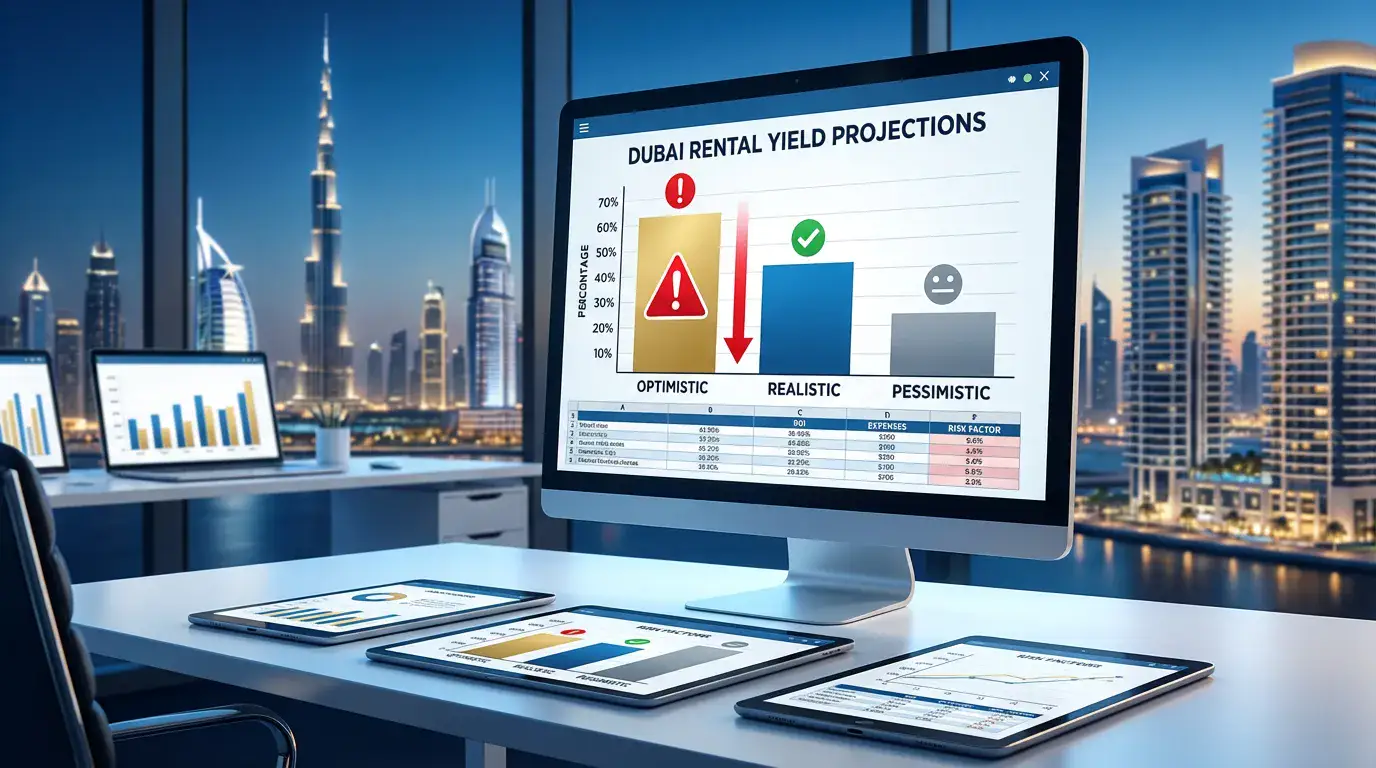
The most expensive mistake in Dubai real estate costs nothing upfront — it’s simply believing the brochure.
Common ROI mistakes Dubai property investors make include:
- Accepting developer-projected rental guarantees at face value
- Using gross yield figures without deducting real costs
- Skipping investment property due diligence in Dubai entirely — no service charge verification, no vacancy analysis, no stress testing
How to stress-test rental yield in Dubai is straightforward: model three scenarios — optimistic, realistic, and pessimistic — across rent, occupancy, and cost assumptions. If only the optimistic scenario works, walk away.
Rental yield optimization in the UAE ultimately comes down to conservative underwriting, verified Dubai real estate ROI data, and treating every rental yield Dubai mistake on this list as a checklist — not an afterthought.
Due diligence isn’t a box-ticking exercise. It’s the foundation of every profitable Dubai buy to let investment.
13. How Smart Investors Boost Dubai Rental Yield (Action Checklist)
Avoiding rental yield killers in Dubai is half the battle. Here’s what high-performing Dubai landlords actually do:
✅ Choose low service charge communities — prioritize net yield over gross yield optics
✅ Price using RERA’s Dubai Rental Index — data beats gut feeling every time
✅ Budget for 1–2 vacant months — build vacancy into your base case, not your worst case
✅ Maintain the property proactively — small fixes prevent expensive tenant exits
✅ Stress-test your financing — model mortgage costs at multiple interest rate scenarios
✅ Screen tenants rigorously — quality over speed, always
✅ Pick the right unit type and location — studios and 1BRs in high-demand communities consistently lead Dubai rental yields
✅ Stay cycle-aware — buy in undersupplied segments, not at peak hype
✅ Run conservative ROI projections — if it only works on paper, it won’t work in reality
This is a Dubai buy to let strategy stripped of wishful thinking — and built on rental yield optimization in the UAE.
14. Quick Comparison: Gross vs Net Yield Example Table
Two properties. Similar gross yields. Vastly different net returns. This is exactly how service charges on Dubai apartments and hidden costs separate smart investments from disappointing ones.
The table below strips away the marketing gloss and shows the real gross vs net rental yield in Dubai — line by line:
Cost Item | Property A (Luxury Tower) | Property B (Mid-Market, JVC) |
Purchase Price | AED 1,500,000 | AED 900,000 |
Annual Gross Rent | AED 97,500 (6.5%) | AED 63,000 (7.0%) |
Service Charges | AED 22,500 | AED 7,200 |
Maintenance Allowance | AED 5,000 | AED 3,000 |
Vacancy Allowance (1 month) | AED 8,125 | AED 5,250 |
Mortgage Interest (est.) | AED 28,000 | AED 16,800 |
Net Rental Income | AED 33,875 | AED 30,750 |
Net Rental Yield | 2.26% | 3.42% |
Property B wins — decisively. Rental income vs purchase price in Dubai tells only half the story. The net rental yield Dubai vs gross gap is where investments are made or broken.
Conclusion: Protect Your Dubai Rental Yield, Not Just Your Capital
Avoiding these 10 rental yield Dubai mistakes is the difference between a Dubai buy to let investment that genuinely performs and one that merely looks good on a brochure. Strong Dubai real estate ROI isn’t accidental — it’s built on realistic assumptions, sharp due diligence, and disciplined cost management across every line item that affects cash flow from your Dubai rental property.
Map Homes Real Estate helps investors cut through the noise with data-driven analysis tailored to your target community, budget, and goals.
Get ROI projections for any project — including full breakdowns of service charges, vacancy allowances, mortgage costs, and market cycle positioning — so you invest with clarity, not hope.
Frequently Asked Questions
Deduct annual service charges, maintenance, vacancy allowance, and mortgage costs from gross rent, then divide by purchase price. Net rental yield in Dubai is typically 1.5–3% lower than gross yield.
Absolutely. In premium towers, service charges alone can erode 2–3% off your gross yield. Always verify actual service charge rates before purchasing — not developer estimates.
It depends on location and management capacity. Short-term rentals in Dubai can generate higher nightly rates but carry seasonal vacancy, licensing costs, and platform fees that often neutralize the advantage.
Yes — selectively. Dubai remains one of the world’s strongest buy-to-let markets, but yield quality varies sharply by community, unit type, and how well investors manage costs and vacancy.